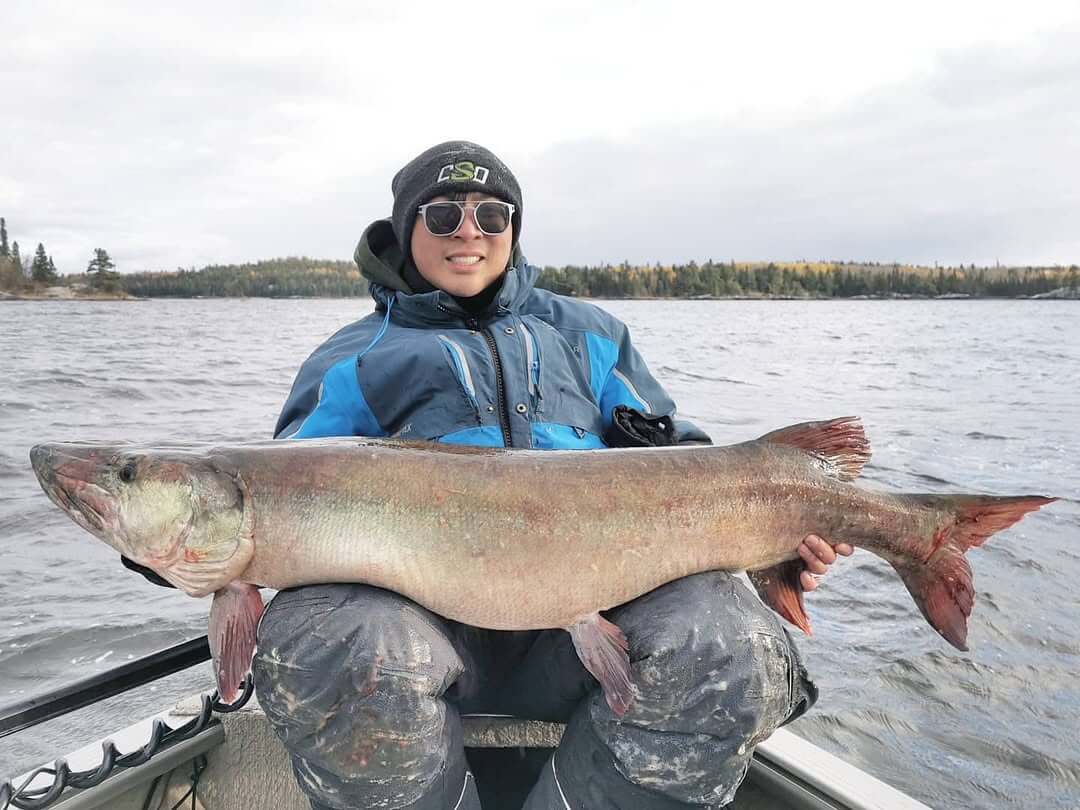
It was a snowy freezing day on Lake of the Woods in late October. We were trying for three days to catch a muskies at that point without having landed one. We were pretty green to trolling so often we ran lures into rocks. Pike would often strike wasting precious time. Going around a point I suddenly saw my rod bend like dead weight. The graph showed that we were in 30 feet of water but somehow at the moment I was wondering again to myself how I managed to snag my crankbait. I tried releasing line but the lure wouldn’t come free. So we drove on top of the snag when I started to feel some slow shaking in the rod. After an extremely anti-climatic battle, we netted a 51″ tank musky. It was my second musky ever and was a moment I would never forget. I could barely lift the thing and had to support it on my knees.
Doing fall muskies in northwest Ontario is something I do occasionally. I am blessed that I live not too far away from some of the best musky waters in the world so I have to give it a shot from time to time. Some people say it’s boring, some say it’s too hardcore and some will say it’s the greatest thing ever. I can understand these feelings, it’s definitely not easy but it can be rewarding. I may not be the greatest musky angler out there but I will provide what I know to help you potentially land a fish of a lifetime.
Advantages of Trolling
Trolling may not be spectacular but it covers more water than any other technique. In the fall as the water cools and muskies need to nourish themselves before winter arrives. A big predator like a musky knows that the best way to make it through the winter is to burn as few calories as possible while consuming the most amount of calories possible. This is also the time when big oily fish like whitefish and ciscoes concentrate on main lake structure. These are perfect musky food with their soft fins and fat content. Trolling is a good way to eventually intersect these pods of baitfish. In massive shield lakes, exploring basin edges, neck downs and islands where baitfish hang out can take forever if you cast.
Probably the biggest advantage of trolling is that I don’t have to cast. As much as it’s awesome to catch muskies casting, it puts an incredible toll on your body. I have gone on long musky outings where I would end up waking up in the middle of the night in pain. Trolling requires no physical effort aside from driving the boat. Though when battling the elements, you will get tired as well so it’s still relatively hardcore fishing.
As a bonus (for some people), this is also a time where big pike are caught. Some of my biggest pike have been caught while musky fishing as they often target the same baitfish. Small ones are annoying but I don’t mind a big pike from time to time to add to the photo album.

Equipment
Rod, Reel and Line
Generally with trolling I recommend a very strong fiberglass or composite rod. You need to handle cranks that may be a foot long and will have extreme vibration. The extra bendiness absorbs a lot of shock and keeps hooks pinned. My personal rod is a Chaos Tackle Assault Stick 9′ trolling rod. Though glass rods are not that expensive and I’ve heard of people using the Shimano TDR (which are ultra cheap). In general these rods should not be too fancy as you never have to hold them and they get beat up in the rod holders. Long rods help to maximize the spread of lures as well and help keep fish pinned.
The reel should be large enough to hold lots of heavy braid (80# minimum). It should have a line counter as this will help you determine how much line you need to let out. I personally run the Okuma Coldwater Line Counter reels as they aren’t too expensive but dependable enough.

The good thing about the trolling setup is that it can also be used for sturgeon and catfish. The slow action and large line capacity is very suitable for bottom fishing for big scavengers.
Lures
This is where the wallet really takes a beating. Generally the approach is to use big wooden crankbaits that 10, 12 or even 14 inches long. These lures are built to withstand beating rocks and are engineered for a lot of wobble and flash. Even the budget options like the Musky Mania Jake isn’t cheap costing $40 CAD for a 10″.
I can’t say I have experience with all of them though I’m sure that if you spend a lot of time with one and understand its depth curve you will have success. I personally stick with the Supernatural Big Baits Headlocks and Matlocks. These are incredibly costly lures in the $150 CAD range. They are engineered to wander side to side a lot. The Headlock being thinner is great at higher speeds while the Matlock is fat and works better at lower speeds. They both have a metal lip which takes a ton of abuse and they have three settings that can be adjusted for depth and action.

Regardless of what lure you use, use a trolling leader which is several feet of very heavy fluorocarbon. Trolling often involves touching rocks and braid has low abrasion resistance.
Rod Holders
Musky anglers tend to be heavily invested in rod holders. I personally use Scotty Orcas which I like for being able to yank the rod out quickly by pulling straight up plus they work with my Lund Sport Track. I’ve even seen them used on the Fraser River for white sturgeon. Since it’s plastic, consider a rod leash just in case of failure.
A lot of people would probably disagree with me and I’ve heard lots of people use Down East rod for their durability. They are pricier though. I’ve heard that rod handles get chewed up when trolling cranks at high speeds. There’s also the Fat A.Z. holders which can be tipped up and down.
Other Equipment
There is a lot of equipment to consider when musky fishing to ensure their survival. If you musky fish a lot already, you probably already have a lot of these. Make sure to have a big thick mesh net several feet deep to be able to unhook fish in the water. Make sure you have a pair of bolt cutters to cut hooks to get muskies back to the water faster. Get a thick bump board to properly support a giant musky to get measurements.
Locations
The thing about trolling is that you can cover lots of water. You will inevitably hit prime locations while going through bad ones, even if you’re an absolute beginner.
It may seem daunting to pick a location to troll. I’ve fished massive lakes like Lake of the Woods and Eagle Lake where there seem to be endless options. The waters may not necessarily be guaranteed to be mapped as well as large parts of the Canadian Shield waters are uncharted. The best thing to do is go into Google Maps and stay zoomed out. Think about macrostructure at this time of the year as opposed to microstructure. Pick large island chains or shorelines that relate to the main lake basin. Often when trolling, you want to maximize the amount of time your lure stays in the water so identify routes that you can troll on for a while. Sure there are tiny islands and reefs that will likely hold a musky but you probably are better off on a long trolling run. When you don’t have a lot of knowledge, efficiency is the key to catching.

Trolling
Trolling for muskies is easy once you get used to it though it does feel like an extreme version of trolling compared to other freshwater species. A lot of it is experimenting until things seem to work.
Running the Lures
First of all figure out how deep your lure will run. There may be some charts online that tell you approximate depth based on line out and speed. Though most of the time you will be experimenting. I typically want to run a few feet above my target depth though you will go shallow and deep from time to time. I typically run my lures about 12-15′ deep but can catch in 30′ at times. Generally it’s not a huge concern to be a few feet off bottom, a large musky isn’t going to have issues chasing a lure a few feet above it. Remember, lots of the whitefish and ciscoes are suspended near structure so you kind of want to be in their range. Sometimes you run a little shallow and it’s ok as sometimes the lures bouncing off rocks can trigger strikes. When you really know the water well, you can troll to ensure that the lures hit rocks without snagging.
If you are in unfamiliar waters, there’s a good chance you will run into water too shallow from time to time. This is why when you set your drag, it should peel off if you accelerate suddenly. Yes it should be set very light. That way a snagged lure isn’t likely to result in a broken line or rod holder and is a bit easier to retrieve. Most lures can pop off simply by immediately slackening the line with a quick jerk of the rod. Even though the drag is light, there should be no issues when the fish strikes.
In terms of speed, I have done anywhere from 3-5 mph which are largely dictated by the water temperature and lures. The later in the season, the slower I like to run. Some lures like the Matlock work better at slower speeds and Headlocks can run at really high speeds.
Electronics
I highly recommend a fish finder that has live mapping capabilities which shouldn’t too hard to get. Most modern entry level fish finders have some sort of live mapping capability. If you have one screen only, split the screen with half being mapping and the other with 2D sonar. Watch the 2D sonar to maintain the right depth. Ensure that you have a speed reading on your overlays to ensure you’re maintaining a proper speed. Watching for baitfish might give you clues as to which areas are more productive.
The live mapping will create a rough depth map as you troll, the more passes you make the more accurate the map becomes. You can analyze your mapping later to understand how to make better passes that can be tighter to shore but not running into shallow water. Best of all, your mapping can be saved for future trips and you’ll have even more efficient trolling passes the next time you come back.
If you do happen to have the luxury of a second screen, I like employing side imaging. It’s not extremely critical to musky fishing but if you’re good at reading it, it provides a source of passive information that may come in handy. Perhaps you caught a musky because you passed some boulders or weeds. Maybe if you’re like Doug Wegner you can spot fish on it. Side imaging while useful is one of those tools I feel many average anglers are not very good at using, myself included. Though I try running in hopes I can get better at it.
The Strike
One of the best feelings of trolling is hearing your rod bend and the clicker releasing line after hours of no action. Though it can get pretty hectic. I do highly recommend fishing with a partner as musky fishing is very much a team effort.

When the fish strikes, the first thing to do is to grab the rod and get it out of the holder. If you’re the boat driver and your rod goes, dive for the rod and have your partner take over control of the boat. Whatever you do, do not slow the boat down or shift to neutral gear as a sudden loss in speed can slacken the line. I wait until the one fighting the fish is in a comfortable fighting stance before shifting to neutral.
As the person fighting the fish, focus all your efforts on fighting the fish. You don’t need to set the hook as the bend of the rod and speed of the boat have already set the hook for you. Generally muskies kind of fight like wet diapers so it’s not extremely spectacular. Though from time to time, relay to your partner how much line is on the line counter as they will be doing other tasks.
As the other person, once the boat is in neutral, reel in the other line. If the boat is drifting into shore, slowly drive it away to ensure that you have enough space to drift for a while. Then get the net. As the nets are really deep, hold the bottom of the mesh while scooping the fish and release as the fish is in the net.
The unhooking process is the same for all musky anglers. The giant crankbaits often have multiple treble hooks that will have tangled up in the net and the fish’s mouth. For this reason, bolt cutters are highly recommended so that you can get the fish unhooked really fast. Hooks are cheap but muskies are precious. While the fish is unhooked have the other person prepare the bump board and camera to document the catch. Fall temperatures make it easier for fish to recover but definitely take good care of them.

A Word on Casting
I know this is a trolling article and sometimes we just hate casting because of how much work it is. Though if you are going on a musky trip, make sure that you have a casting arsenal ready. Sometimes you plan for your dream trip only for a warm spell to keep water temperatures high. Even it late fall, the fish could be very shallow. Sometimes we still catch them in a few feet of water as if it were like summer. Generally tubes, jerkbaits and big rubber are what I used for these fish.

Final Words
As much as it feels like ice fishing is around the corner, consider going for muskies at this time of the year. True it’s miserably cold and the fishing is hard. People love the idea of musky fishing until they actually have to do it. Though if you endure the elements and put the hours into it, you might be boating the fish of a lifetime. We anglers work hard for a few moments of the day but it’s even more extreme with muskies. Plus as a bonus, very few anglers will be left on the water and you can have a lot more peace and enjoy your surroundings.
Musky fishing has been one of those things where I learned entirely by myself and I am glad to share what I was able to learn. I’m far from a musky expert but I have boated them and hope that this advice will help you boat one yourself.


![[VIDEO] The Minnesota Sturgeon Excursion](https://i0.wp.com/fishingprairieandshield.com/wp-content/uploads/2023/05/maxresdefault.jpg?resize=319%2C142&ssl=1 "[VIDEO] The Minnesota Sturgeon Excursion")
![[VIDEO] The Search for an Eagle Lake Musky](https://i0.wp.com/fishingprairieandshield.com/wp-content/uploads/2022/11/IMG_20221106_191343-scaled.jpg?resize=319%2C142&ssl=1 "[VIDEO] The Search for an Eagle Lake Musky")