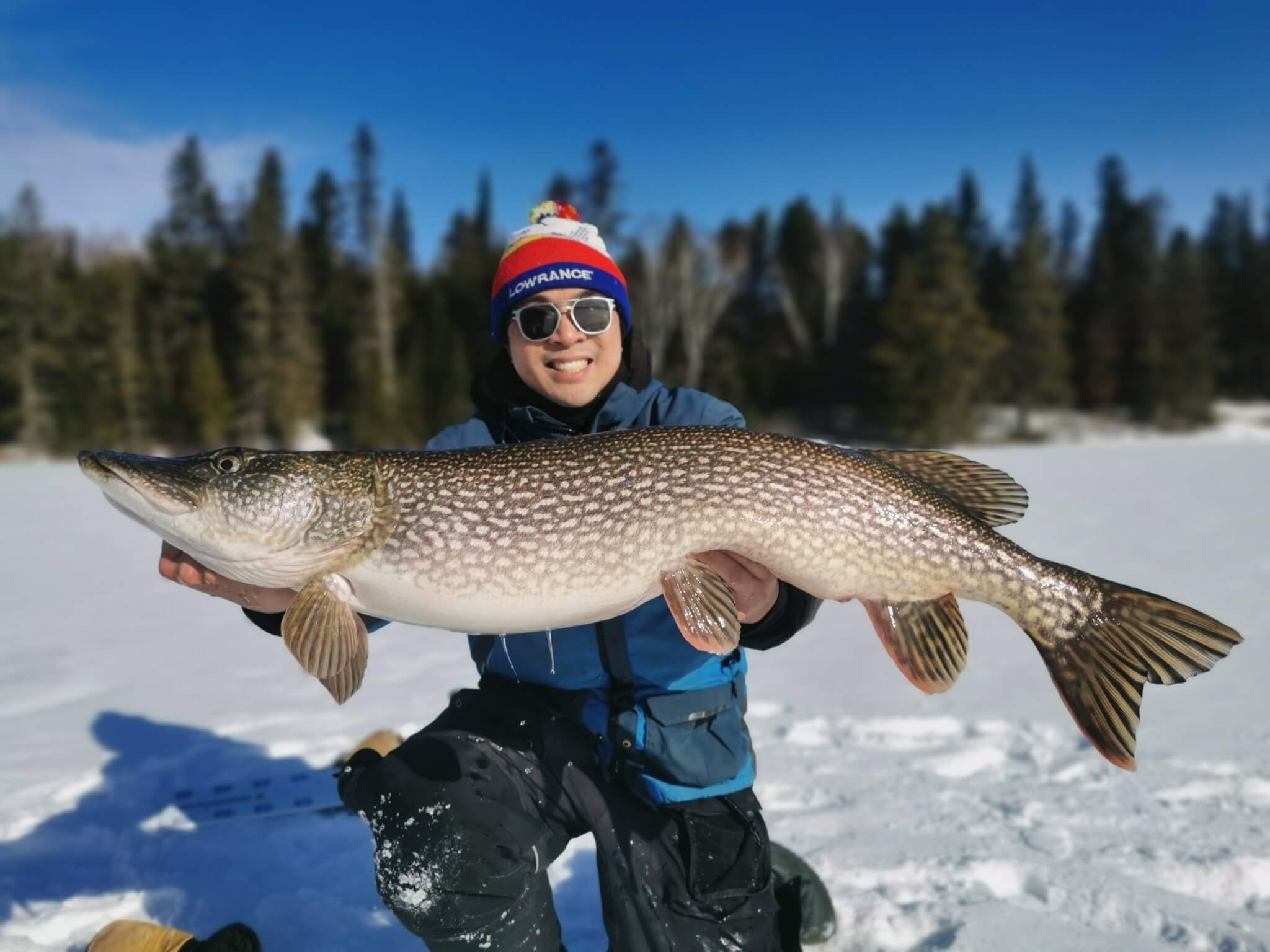
One of the best feelings in ice fishing is seeing a flag stick out of the snow. There’s a mad dash to the tip up and then you see the spindle spinning like crazy. You grab the line and set into the fish only for it to feel like a snag. After a few tense runs of line ripping through your fingers, a giant jaw appears in the hole. After a few hero shots, you excitedly post your catch to social media and watch the likes accumulate. Then after a day, you settle back into your boring routine and start daydreaming again.
Tip up fishing is one of my favourite methods of fishing and is very easy to do. I do think it’s underutilized though and more people should try it out as a side option. I’ll explain how to setup your tip up and use it to bring up a snot rocket onto the ice.
Why Tip Ups?
Tip ups should be an important part of every ice angler’s arsenal. They are inexpensive and pretty easy to store. Most importantly, they’re effective.
Big pike are actually quite lazy (energy efficient is probably the better word). Like most apex predators, they live as long as they do because they know to expend as few calories as possible while eating as many calories as possible. A big dead oily suspended bait is perfect for them. We mostly think of northern pike as active hunters but they do scavenge a lot of their meals as well.
Probably the biggest reason why I like to use them though is that in certain fisheries, there isn’t anything better to do with your other line. Most jurisdictions allow two lines. When I fish for crappies in the Canadian Shield for example, I can only realistically manage one line for them. A tip up off to side might catch a pike here and there in case my main fishing isn’t working well. Sometimes it is the tip up that actually saves you from looking like a failure when you get that big pike at the end of the day.

Plus the design of a tip up allows for the spool to be underwater at all times. Unlike most other forms of set lines, you do not have to clear your holes as much since the spool is able to release line freely even with a layer of ice on the surface.
Buying and Assembling Your Tip Up
Fortunately the whole setup is very cheap. The highest end tip ups tend to be around $40. The most common styles are rectangular shaped or circular shaped. The rectangular ones I find are cheaper and easier to carry in a pail. The round ones provide insulation allowing holes to stay liquid a bit longer. Though both function similarly.

The next thing you need is Dacron line. Dacron is designed to be used with bare hands as it’s strong and will not cut into your hands like superbraid. Get at least 30lb test. When you spool the tip up ensure you use a bit of electrical tape to secure the knot to the spool so it won’t slip.
Next thing you need is a quick strike rig. There are quite a few variations of these rigs but generally most of them have two relatively small trebles. Some have blades that create flash when there is a bit of movement or current.
What I like to do personally is to get really tiny round bobbers. This is purely optional but I find that a small indicator on the line helps to reset the tip up fast.
If you can get those clip weights as well that will help get your rig to the bottom fast when setting up.

Bait
All you really need to do is visit your local grocery store. Mackerel, sardine and herring are probably the best baits you can get. I like to make sure they are around 10 inches long.

If you can, wild caught tullibee, chubs and suckers can be really good though they’re much harder to get. Sometimes if you are well connected, you check out the bycatch of commercial fishermen and see if they have these fish discarded on the ice.
In terms of size, people think big baits will attract big fish. This is not strictly true as I have caught many 20” pike on 10” baits while having caught 40”+ fish on 6” baits. I find that small pike are just going to strike anything so I think about how I would catch a big fish. In the midwinter, pike tend to be a little bit more lethargic so the smaller bait actually might be more advantageous. Towards the late season, when big pike are in the ultra shallows, I like to go back to the bigger baits where they are a bit more aggressive and actively feeding.
Big Pike Locations
In general, if you want big pike, you want big waters. Statistically speaking, large bodies of water will produce the biggest fish.
I feel that in midwinter they tend to be a little less concentrated. I tend to not fish for pike at this time of the year but I do setup tip ups when fishing for other species. I typically set up my tip ups near shore, usually on a point if I can. I have to figure that at some point a pike has to wander by to eat the fish I’m actually trying to target. I have landed some big pike doing this so it must be working. If you have multiple tip-ups, it’s best to vary the depths to see what works the best. If you fish a river system, a backwater is a good place as they want to escape the current.


Late winter is when people tend to get excited for big pike, for a good reason. It gets warm in March allowing anglers to fish outside more often. The more important reason is that pike are making their way to the spawning grounds and roaming the shallows for easy meals. This is classic late winter fishing where a group of anglers watch a spread of tip ups. Typically a shallow soft bottom bay with creeks flowing in are prime March locations. It’s not unusual to catch pike with less than two feet of water under the ice, my biggest pike ever actually came out of two feet of water.

Setting up the Tip Up
Once you’ve picked your spot and drilled the hole, it’s time to deploy the bait.
Most people hang the bait a foot off bottom, so you will need a way to figure out where bottom is. Every tip up angler should have a weight clip. Clip the weight to your quickstrike rig and drop it to the bottom of the lake, then raise it where your bait should be. This will tell you how much line you need to have out.
Some people might just bait the rig at this point but I prefer some way of reliably resetting it fast. I like clipping a small bobber as a marker. Alternatively, I like to lay the line on the ice and make a mark in the snow indicating how much line I need let out.
Regardless of the rig, hook the bait so it hangs horizontally. It may not sink easily as there may be air in the body cavity. Take a knife and puncture the bait. Then hold the bait underwater and watch for air bubbles as you squeeze it, indicating that you are letting air out. Then as soon as the air is out, drop the bait and it will slowly sink down.

Typically the flag will need to be bent and locked under a groove on the spindle. There are typically two different groves on the spindle. You want the deeper one most of the time as you have heavy baits and pike need a bit more time before tripping the flag.

On colder or snowy days, you may want to consider a hole cover to keep your hole free. You can buy hole covers or you can cut them from foam mats.
Flag!
This is why people enjoy pike fishing as seeing a flag is exciting. When approaching a flag, walk slowly especially if you’re in shallow water. Fish can sense footsteps and potentially may drop the bait. Bring your release tools and bump board with you.
Watch for the spindle spinning. If it’s not spinning, watch it for a few seconds to see if will move. If it hasn’t moved, remove the tip up and pick up the line slowly until you confirm whether there is a fish on or not. If there is no fish, reset the tip up. It’s not uncommon for small pike to trigger the flags.
If it’s spinning fast, remove the tip up from the hole, grab the line and set the hook. Don’t yank too hard but just a sharp snap of the wrist is typically good enough. Then hand over hand retrieve the fish. Throw the excess line on the ice downwind to avoid tangles. If you do get into a big fish, you will need to let line slip through your hands, like a manual reel drag.
When unhooking a big fish, I like to hold it by the gills under water. This also protects the fish from the cold and wind. If you have two people, you can spread a pike’s jaw with your hands, one hand hold the gill flap and the other other the side of the upper lip. Your partner can get into the mouth freely with a pair of pliers or forceps. Be fast with the fish out of the water and release it. Alternatively it’s worthwhile to keep some small pike for the table. Cold water pike are excellent table fare.
Final Words
Pike are one of those fish nobody likes until they fish for them. Watching flags in a group, having fun and making memories are some of my favourite winter moments. On top of that, watching a monster pike’s jaw fill a 10 inch hole is always an unforgettable experience. Hope this post helps you potentially land a pike of a lifetime.